(929) 266-3952
BESSIE BUCHANAN
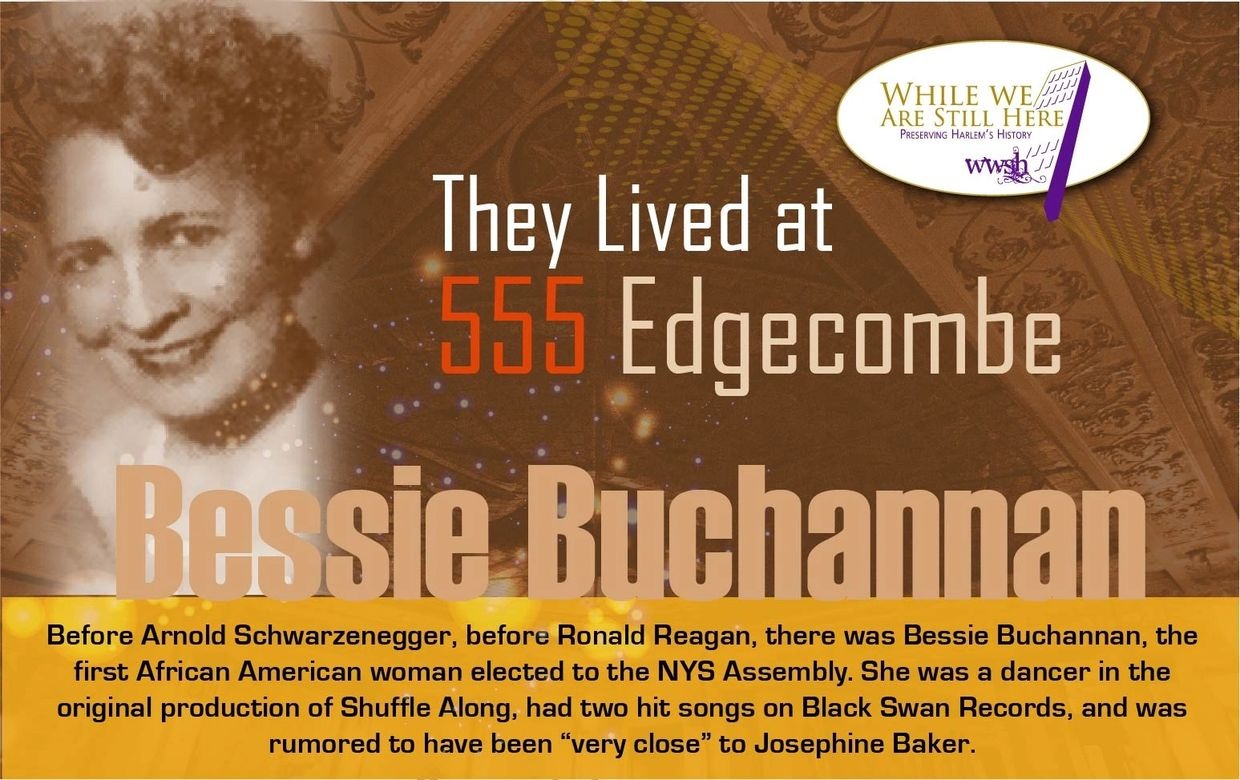
Born March 7, 1902, to Virginian parents who had recently migrated north to New York, Bessie Allison Buchanan came of age during the Harlem Renaissance. She was raised in the city’s theatrical district, emerging from her youth fully perceptive of the new opportunities arising for young Black Americans.
Buchanan first graced the public eye as a performer, with appearances in the 1925 edition of Plantation Revue and in the integrated cast of Lucky (1927) and the original Shuffle Along (1921)¬–the first successful musical comedy with an all African American cast. She was highly revered and listed among performers like Josephine Baker, her dear friend, whom, in the 1950s organized a protest against the Stork Club after an incident of racial misconduct.
In her performance career, Buchanan performed with the Show Boat road company, recorded for Black Swan Records, and danced in the chorus line of the famed Cotton Club, all while actively working in the Harlem Woman’s Civic Club. Having become one of Harlem’s social elite, Bessie married prominent Harlem businessman Charles Buchanan in 1929 and retired from her performing career.
Buchanan was nominated by the New York City Democratic Party for State Assembly in 1954, where she prevailed victoriously and became the first Black woman to the State Assembly. She served four terms in office. Later in her career, after a political shift of party support, Buchanan endorsed Republicans Governor Rockefeller and Senator Jacob Javits.
For five years, she served on the New York State Commission of Human Rights. After leaving public office, but never the public eye, Bessie Buchanan suffered a short illness and passed away in 1980 at the age of 78.