(929) 266-3952
JANE BOLIN
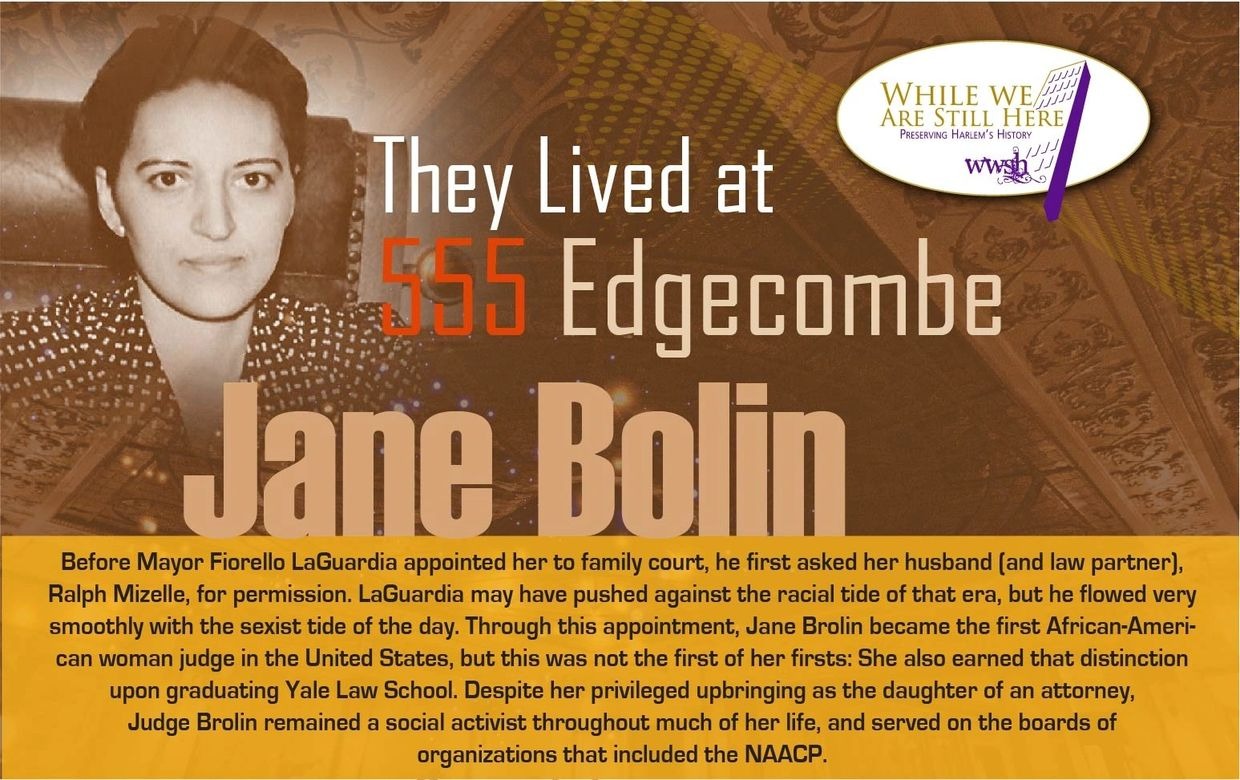
Jane Bolin was the first African American woman in the United States to be appointed to the bench. This distinguished jurist served in family court for forty years. Because of the retirement-age requirement of 70, she left the bench and served on the New York State Board of Regents.
Bolin knew early on that she would pursue a career in law, inspired by her father’s profession, but even he, initially, did not support her decision to study law. Her father, Gaius Bolin, was, also, the founder of the Poughkeepsie chapter of the NAACP.
She was a top student at Wellesley—a Wellesley Scholar—yet, an advisor there tried to discourage her from applying to Yale Law School due to her race and gender, but she became the first African American woman to graduate from there. She married fellow attorney, Ralph E. Mizelle. They opened a law practice together, Mizelle and Bolin.
As a family court judge, she adjudicated cases that included domestic violence, paternity suits, and crimes that minors committed. Also, she chose not to wear judicial robes in order to make children feel more comfortable.
Her humanitarian nature was apparent. She strove to be a beacon for social justice. In an interview with her hometown newspaper, the Poughkeepsie New Yorker, she called out segregation there, stating that “Poughkeepsie is fascist to the extent of deluding itself that there is superiority among human beings by reasons solely of color, race or religion.” In regards to women’s rights, she proclaimed, “We have to fight every inch of the way and in the face of sometimes insufferable humiliations.”
The video highlights Jane Bolin’s father, Gaius Bolin, and includes commentary about her by her family members.
THE GAIUS BOLIN LEGACY AT WILLIAMS
Gaius Charles Bolin Sr. was the first Black graduate of Williams; he arrived in 1885 and graduated in 1889. 2015 marks 130 years since he matriculated to the college. Lionel Bolin ’48 and Lauren Hobby ’10 are the only Bolin ‘legacies’ to have attended Williams, but in many ways every student that has attended Williams after Gaius owes a debt of gratitude to him. The Williams Black Alumni Network (WBAN) worked with college and alumni partners to celebrate this legacy on campus from April 8 to 10