(929) 266-3952
THURGOOD MARSHALL
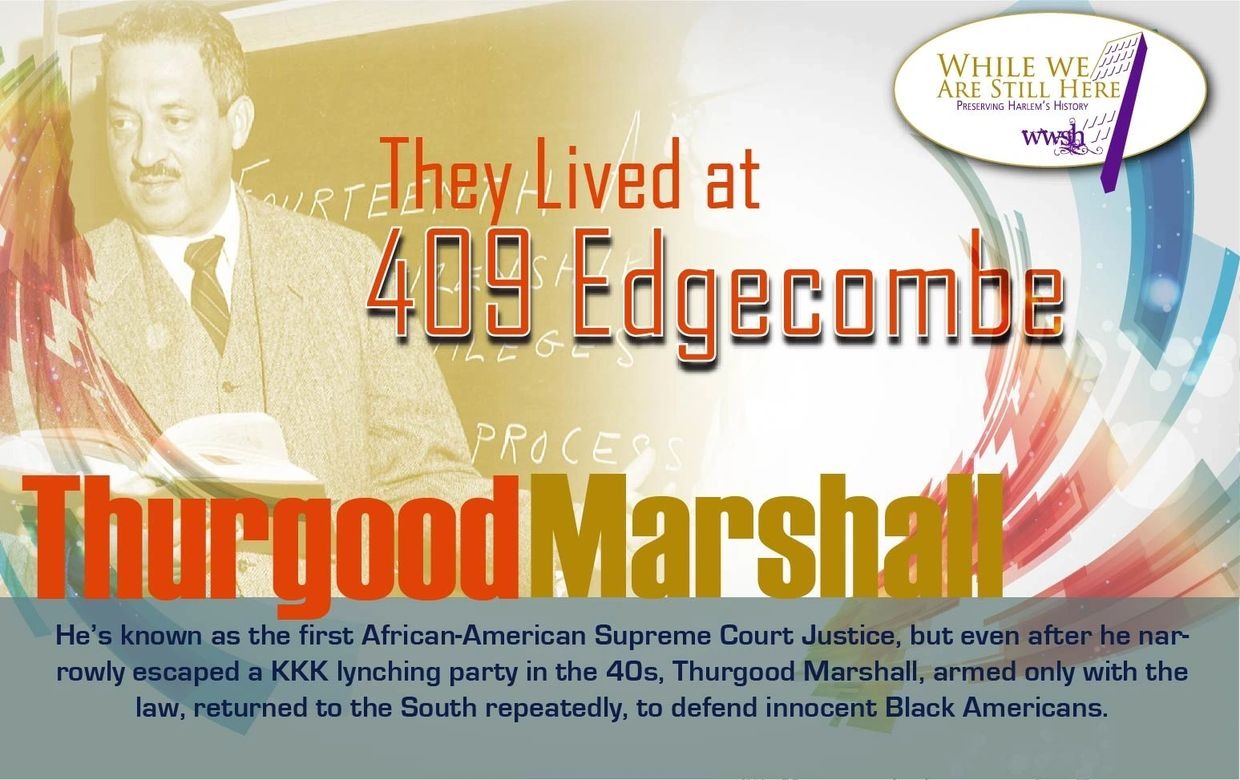
Thurgood Marshall is a historic icon, whose work symbolized the successes of the Civil Rights Movement of the 1950s and 1960s. But there is an elder at 409 who remembers him as her kind neighbor, who helped her push her cello up the steep hill on 155thStreet, on her way to music lessons, when she was a girl.
To some Black, radical revolutionaries of the late 1960s, through the early 70s, organizations such as the NAACP, and individuals such as Marshall were considered too “accommodationist.” During that era, it would have been very interesting to find out how many Black revolutionaries knew that Marshall possessed an outsized bravery, along with his legal commitment to gain equality for African Americans.
All by himself, Marshall would get on the railroad from New York’s Penn Station, heading south, unarmed, to the scary, brutal hinterlands of America, where the Ku Klux Klan ruled. Marshall went to defend innocent Blacks, in towns where the judge was the Klan, the prosecutors were the Klan, the jury was the Klan, and darn near everybody else was the Klan.
For less-noted cases, he frequently traveled alone, but for trials that were public spectacle— Groveland, Florida’s case, for one—he had a team of attorneys. One of his colleagues, a Jewish attorney from New York, Jack Greenberg, saved Marshall from the noose and the torture he would have surely experienced at the hands of the lynch mob assembled in the backwoods of Florida. For many attorneys, a near lynching would have been enough to scare them away from continuing such dangerous work, but that didn’t stop Marshall, whose team went on to win the Brown v. Board of Education of Topeka, Kansas case, outlawing segregation. In his arguments, Marshall used the famous Doll Test that was developed by Drs. Mamie and Kenneth Clark, who lived at 555 Edgecombe Avenue. He retired from the United States Supreme Court in 1991, after serving for twenty-four years.